


Where new writing finds its voice

News & Events

PP16 launch party


PP16 Launch Party, 3rd August 2010

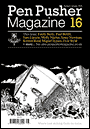
We're delighted to announce that the PP party to launch issue 16 is being held at the Betsey Trotwood in Farringdon.

Featuring: Niven Govinden, John Osborne, Jon Stone, Travis Elborough, Sarah Hesketh & Tim Wells. Because we're worth it... & so are you!

It's also a chance to pick up the latest issue of PP, which includes short fiction by Miguel Syjuco, Kirsten Reed, and a special Donut Press feature with extracts from their upcoming titles by AB Jackson, Ahren Warner, Jude Cowan, Matthew Caley, and Wayne Holloway-Smith. We also feature poetry from Paul Birtill, Emily Berry and Molly Naylor, and fiction from Niven Govinden, Jenny Newman and Abby Fung + much, much more.

We hope to see you at the party, but if not, make sure you pick up a copy of PP16 in one of the capital's great independent bookshops.

PP also featured in a great piece in the Independent by Rob Sharp the other week. Read the article online on the Independent's website if you haven't had a chance to do so yet.

Just a wee bit of business: please note that Pen Pusher's submissions policy has changed. Read more here.

Thank you for your continued support and we hope to see you on the 3rd.

R.s.v.p. to let us know that you're coming.


19 July 2010

An interview with poet Adam O’Riordan

Adam O’Riordan
Adam O’Riordan, photo by Mark Pringle


Pen Pusher caught up with poet Adam O’Riordan to find out more about his remarkable debut collection, In The Flesh.

In the Flesh
ISBN: 0701185058

How long did it take you to complete the collection? Were you
consciously producing a group of poems or did they just grow by a
natural process of accretion?

The collection formed over six or seven years with a very intense
period of writing when I was in residence at the Wordsworth Trust and
a period of editing and redrafting in the year that followed Chatto
buying the book. I was fortunate in having, in Clara Farmer and Parisa
Ebrahimi, two brilliantly insightful and incisive editors.

Are you a writer that needs routine? Or do you tend to obey creative
impulses?

I think both are important. I know that if you ignore an impulse to
create you will be punished for it and another might not come along
for some time. I think the discipline is to stay alive and attentive
to what’s coming. Having a regular routine helps but so does knowing
when you’ve done all you can for the day.

What was it like studying under Andrew Motion? In what ways did the
experience influence your work?

Andrew Motion was, and remains, an important figure in my writing
life. In an era that has been remarkable for the quality of Irish and
Scottish poets, Motion is one of the very best poets England has
produced. His elegies in ‘Public Property’ for the Queen Mother, say,
or those his former mother and father in-law are really without equal.
He has been an exemplar as well as a steadying figure. The best piece
of practical advice he ever gave me was to slow down.

Which place did you find the most creatively stimulating place to live
and why – Oxford, London, or Grasmere?


Grasmere to reflect and create. London and Oxford for life experience.

What is the significance of the title In the Flesh? Does it connote
a greater honesty in your work? Or greater erotic content?

I wanted a title that brought together a set of quite diverse themes:
the visceral, the familial, the carnal, ideas of presence and absence,
of death and decay: In the Flesh seemed to do this quite well.

Why do you have a particular fondness for the sonnet? Do you think it
is stronger or weaker with less formal restrictions (rigid rhyme
scheme + rhythm etc)?

I like the flexibility the form offers especially when there’s a
narrative involved as it helps to maintain focus. I think one way of
keeping form relevant is to reinterpret it. It’s rather like living in
a Georgian house: you can enjoy the space and light it provides but it
doesn’t mean you have to wear a powdered wig.


Several collections that I have read recently seem to be moving
towards a rediscovery of traditional verse forms – is this a trend
that you would encourage?

I think the quality of writing is what’s important: slavish devotion
to any form, or approach, can be limiting. I think good writing both
communicates and complicates and perhaps form can help with. However,
I think the best poets, the Walcotts, the Heaneys, the Wilburs, allow
form to serve them not vice versa.

There is a great deal of narrative and use of the second person across
the collection. Were you consciously trying to remove yourself from
some of the poems? Do you think modern poetry is too frequently
egocentric?

It wasn’t so much myself I was consciously removing as the identity of
others.

One of the most impressive features of the collection is the capacity
for acute observation – does poetry reside in the details?

The poetry I love does.


Many of the poems employ a relatively complex vocabulary / high
lexical density. Was this a conscious decision on your part? Did you
want the reader to have to study these poems carefully before they
took anything concrete away from them?

I hope the poems communicate their sense to the reader immediately but
reward rereading and provide deeper resonances over time. It’s an
idea Philip Larkin believed in and one I definitely subscribe to.
There’s no conscious strategy to the use complex vocabulary. The Roman
architect Vitruvius wrote that a building should have ‘firmness,
commodity, and delight’. I think language should serve a poem in the
same way.


Several poems also deal with death. Why is this a theme that you
return
to?

It’s something I find impossible to make peace with for very long. And
even if you manage to square death for a minute it’s quickly replaced
by the prospect of erasure. There’s that medieval Scots poem by
William Dunbar called ‘Lament for the Makers’ with that chilling,
irresistible refrain ‘Timor Mortis Conturbat Me’ (Fear of Death
Disturbs Me).

After reading your article ‘On Taking up Wordsworth Poet in
Residence’, your comments on the poet’s connection to the public
reminded me a little of C Day Lewis’s A Hope for Poetry. Do you think
that poetry can have a valuable public function? If so, what is it?

I think so. Carol Ann Duffy shows that poetry can respond to, and
invest meaning in, everyday events. In an age when information is all,
poetry makes an extra – and necessary – perspective available. I think
Duffy’s recent poems on David Beckham or the volcano in Iceland prove
this beautifully. Similarly, I’d say Simon Armitage’s long poem ‘Out
of the Blue’ was one of the best responses – in any art form – to 9/11.


7 July 2010

Earthy Anecdotes and Apocrypha

Poet, AB Jackson on the writing of his twenty-one-poem sequence Apocrypha, which is published by Donut Press in November 2010.


* In June 2004 I bumped into Robert Crawford at a Scottish Poetry Library event. He asked me to contribute a new poem for an anthology about St Andrews, which resulted in an anti-St Andrews poem called ‘Apocrypha’. Despite this rudeness it was accepted for the book.

* Later that month, I was sitting in a log cabin in Butterstone, near Dunkeld, trying to quit smoking. Wrote a poem in a similar style about Barabbas. Began thinking of a series (not a sequence) of small fictions, each untitled, under the banner of ‘Apocrypha’. Twenty-one seemed an instinctively good number to aim for.

* I took as my model those writers whose work I still found astonishing after twenty years: Wallace Stevens, and the Geoffrey Hill of ‘Mercian Hymns’. Stevens for his lyrical repetitions – the fire cat in ‘Earthy Anecdote’ and surreal inventiveness: ‘the Socrates of snails, musician of pears ... the lutanist of fleas’; Hill’s hymns for their anachronisms, high historic legend with low present-tense detail.

* With forces in Iraq and the American Christian right running the show, it seemed possible, perhaps necessary, to write mangled religious poetry. To biblical themes, then, I wanted to introduce elements of camp (as I understood it), ie, iconoclasm, high spirits and ‘in’jokes, extravagance, exaggeration, and an alliance with the female. It is only very recently that someone has pointed me to Susan Sontag’s 1964 essay on the subject, which includes statements like: ‘One is drawn to Camp when “sincerity” is not enough.’

* On the female side, the apocryphal poems about Jezebel, Judith and Sarah are ‘about’ real acquaintances with those names. Well, not Jezebel, that’s Julie Anne – but she wrote a song called ‘Jezebel’, and sings O’Connor’s ‘Jerusalem’. Sarah Kobrinsky and I danced a highland fling on the platform of Perth station, once. There may have been drink involved.

* The only way to write such poems was to assume that nobody would want to publish them as stand-alone pieces but to carry on regardless and have as much fun as possible before the endeavour collapsed under the weight of its whimsical perversities. When Gerry Cambridge published four of them in The Dark Horse magazine in the summer of 2005, they began to seem like a viable project with a readership of more than one author and his dog.

* I wrote thirteen of them between June 2004 and July 2005, mostly in The Pot Still on Hope Street, Glasgow, then lost the impetus. The final eight would take another four years. I began to think I’d never get across the twenty-one finishing line. On the day I did, I sent a copy to Andy Ching, and a day later we’d agreed to do a Donut special edition. And I’m delighted!

AB Jackson